A video editor an agent can drive
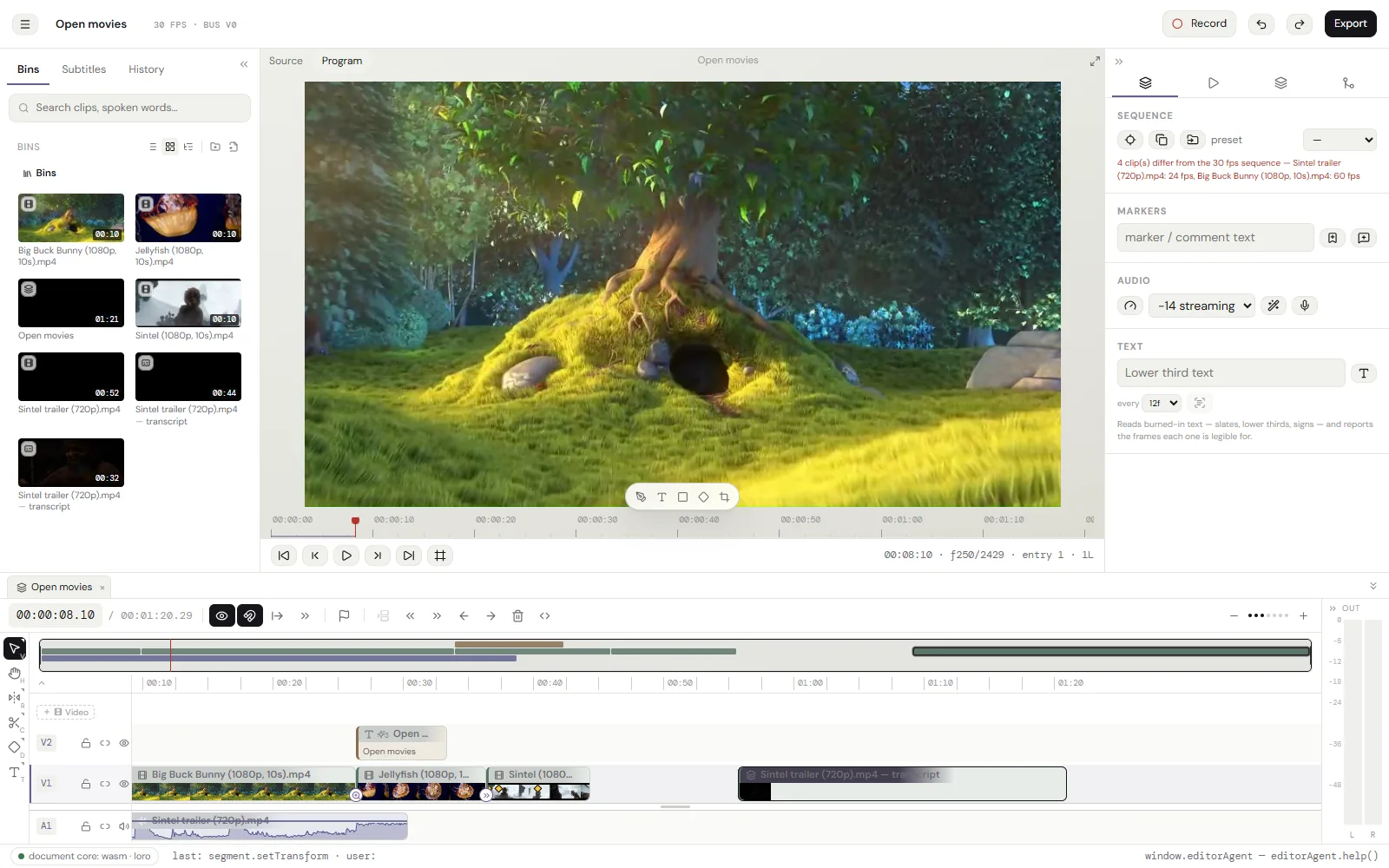
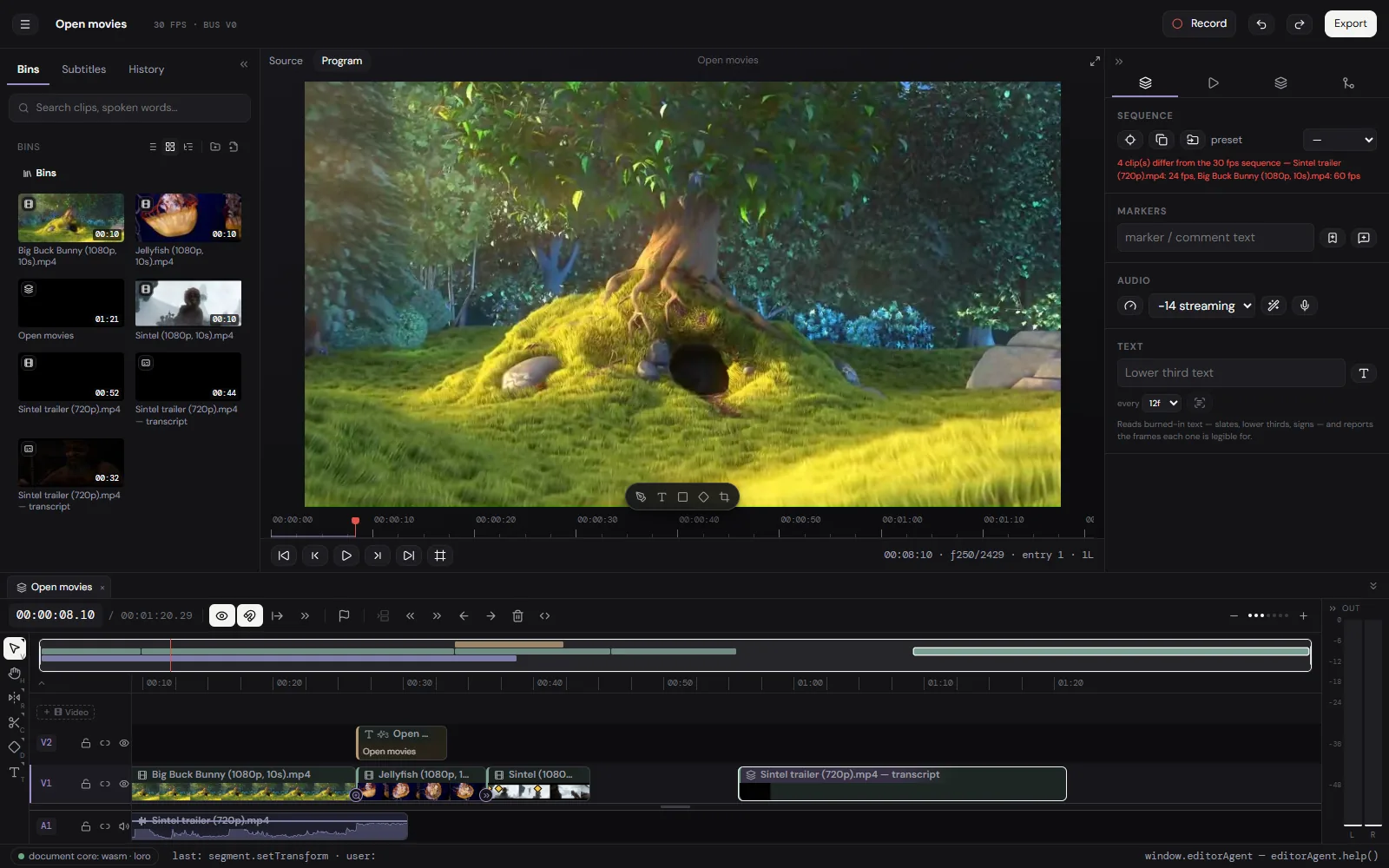
Everything the interface does goes through one command bus, and a script sends the same commands. window.editorAgent is documented, introspectable and reversible, and it edits a real timeline rather than a render template.
Start here
Open the editor and run this in the page. It prints the reference and returns it, so it works as well for a model reading the result as for a person reading the console.
editorAgent.help()             // the whole reference
editorAgent.help('commands')   // commands, state, media, text, program, ui, frames, session, export
editorAgent.describe()         // every command, its parameters, its scope, as data
Why this is different from a render API
The usual way to make video from code is to describe a composition and have a server render it. That is a good way to produce a thousand similar clips and a poor way to edit one real one: there is no timeline to inspect, no footage to look at, and nothing to correct.
Here the agent drives the same editor a person uses. It can read the document, look at actual frames, find a spoken phrase, make a cut, watch what happened, and undo it. The interface is not a layer over the API: they are the same commands.
What a batch looks like
// the document, as JSON
const doc = editorAgent.state()

// find where something was said; the answer is in timeline frames
const hits = editorAgent.findText('pricing')

// one batch is one transaction and one undo unit
editorAgent.dispatch([
  { name: 'clip.split', params: { seq: 'main', track: 0, f: hits[0].startF } },
  { name: 'segment.setTransition', params: { seq: 'main', track: 0, index: 1, kind: 'dip', durF: 12 } },
], { actor: 'agent:me' })

// look at the result the way a person would
await editorAgent.frames(assetHash, 100, 160)   // real frames on one canvas, captioned
editorAgent.program.snapshot()                  // what the monitor is showing
The parts that make it safe to hand over
- A batch is a transaction
- It applies whole or not at all, and counts as one undo.
- Agent edits stay out of the human’s undo
- A batch from an
agent:actor does not land in the undo stack a person is using. - Sessions
- Open one with named scopes, do the work, and revert the whole session in one move.
- Checkpoints
- Name a point and come back to it.
- Dry runs
- Ask what a batch would do before it does it.
- Introspection
describe()returns every command with its parameters and scope, so the surface does not have to be guessed at.- Derived positions
- A segment’s place is the sum of the durations before it. There is no position field to write wrongly.
What it can reach
- The document and every sequence, asset and track, as JSON.
- Import from a File or a URL; transcribe; read the text in the picture.
- Every edit the timeline makes: insert, overwrite, razor, ripple, speed, reverse, loop, nests.
- 34 transitions, 13 entrances, 10 loops, an effect stack, a LUT, chroma key, an anchor and keyframes.
- A per-clip audio chain in one command, and loudness on the way out.
- The programme monitor: seek, play, snapshot, and exact frames rendered for a vision model.
- The activity dock as data, so a long job can be waited on rather than guessed at.
- Export, resolving with the finished run.
Where the documentation is
Three places, all on this origin, all plain text: /AGENTS.md is the reference an agent should read first, /llms.txt is the short pointer, and editorAgent.help(topic) answers in the page itself. The document in the head of every page names the API too, and there is a note in the accessibility tree saying so, because a browsing agent reads that tree rather than the source.
The honest limits
- Export is H.264 video and AAC audio in an MP4, or the sound alone as .m4a. No ProRes, no DNxHD, no H.265 out, no image sequences.
- No team features: no cloud project, no review link, no comments, no shared library. A project lives in one browser, and moves as a file.
- No stock library and nothing generative: no stock clips, no music bed, no AI b-roll, no generative fill.
- No third-party plugins. No OpenFX, no VST, no motion-graphics templates from another app.
- Colour is LUTs and the effect rail, not scopes, curves and secondaries. A .cube grades a clip; there is no vectorscope to grade against.
- Built and checked in Chromium browsers, which is where WebCodecs is furthest along. Other browsers vary by codec and by version.
- It runs in a tab, on one machine. A long 4K timeline is heavier here than in a native application on the same computer.
Questions
- Is there an API key?
- No. The API is a namespace on the page in the browser that has the editor open. There is no server and nothing to authenticate against.
- Can it run headless?
- It runs wherever a browser runs, including one driven by CDP or Playwright. It needs a real browser because the decoding and encoding are the browser’s.
- Can an agent undo its own mess?
- Yes, through a checkpoint or a session, which is why agent batches are kept out of the human’s undo stack.
- Is there an MCP server?
- Not yet. The surface is a documented JavaScript API on the page; anything that can evaluate JavaScript in a tab can drive it today.
- Where do I read the full command list?
- At /AGENTS.md on this origin, or by calling editorAgent.describe() in the page.
Open it and cut something.
No account, no install, nothing uploaded. The first edit takes as long as a page load.