Everything in the box.
53 of them, and every line names something in this build. Free, in a browser tab, with the footage never leaving the machine.
The cut
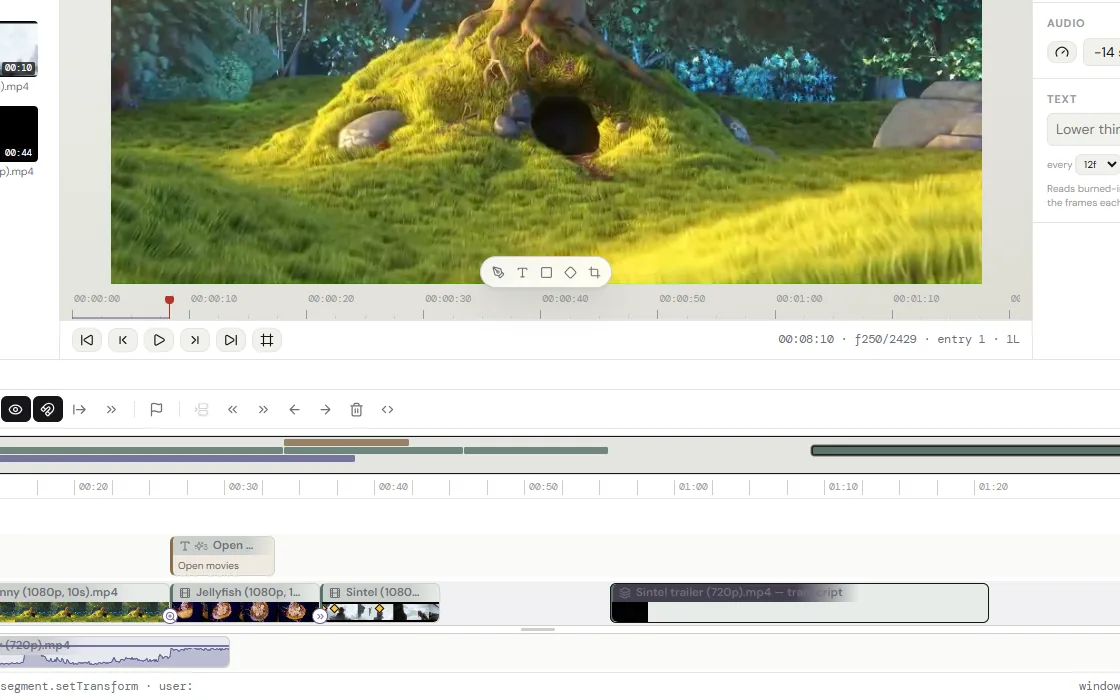
Every edit is a command on one bus, undone the way it was done.
- Insert and overwriteA clip between what is there, or over it. Positions come from the clips; nothing is stored twice.
- Razor and rippleSplit at a frame. Trim an edge and everything after follows, or stays put.
- Sync-locked tracksAn insert on the picture moves the sound by the same frames.
- Track select forwardOne key and a click take every clip from there to the end.
- Freeze framesA half-second hold at the frame, absorbed by the gap after the clip or laid on the track above. The tool shows where the video already holds still.
- Speed, reverse, loopA clip at any rate, backwards, looped or boomeranged.
- Nested sequencesA sequence is a clip in another, with transitions on it, into it and inside it.
- Markers and a gap finderName a moment. Find the one-frame gap that should not be there.
- Linked picture and soundThe halves of a clip move together until told not to.
- History that is the documentUndo, redo and a journal on disk. A closed tab costs nothing.

Picture
Transitions and animations from one catalogue, and a rail for everything else.
- 33 transitionsDissolve, dips, push, wipes, blinds, iris, zooms, whip pan, spin, glitch, light leaks, film burn, or leak footage of your own.
- 13 entrances and 10 loopsFade, zoom, slide, rise, drop, pop, twirl, shake, blink. Breathe, pulse, sway, bob, drift, pan, spin. On any layer, in, during and out.
- TransformPosition, scale, rotation about an anchor of your choosing, skew, crop, opacity, rounded corners and blend modes.
- KeyframesAny of those over time, in lanes under the clip.
- Chroma keyKey a colour out of a clip, or out of a whole nested sequence.
- Grades from LUTsA .cube file is a bin asset. Drop it on a clip.
- Shadows and blurA drop shadow, an inner shadow and a layer blur, each with spread.
- Titles that kernLines set like the type they are. Letters, words or blocks animate in, during and out.
- Shapes, paths, stillsRectangles, a pen for paths, and images on the timeline in their own colour.


Sound
A chain on every clip, and a mix that fills in around the playhead.
- Gain, fades, metersPer clip, drawn on the waveform. The meters read the mix.
- An audio chainHigh-pass, three bands of EQ, denoise, a gate, a compressor, a de-esser, a notch, echo and room.
- Six room presetsVoice, noisy room, podcast, telephone, hall, slapback.
- Auto-duckingMusic dips under the dialogue as keyframes that can be moved.
- Silence stripDead air found and proposed as cuts, shown on the timeline before they are made.
- LoudnessAn export normalised to a LUFS target.


Speech and text
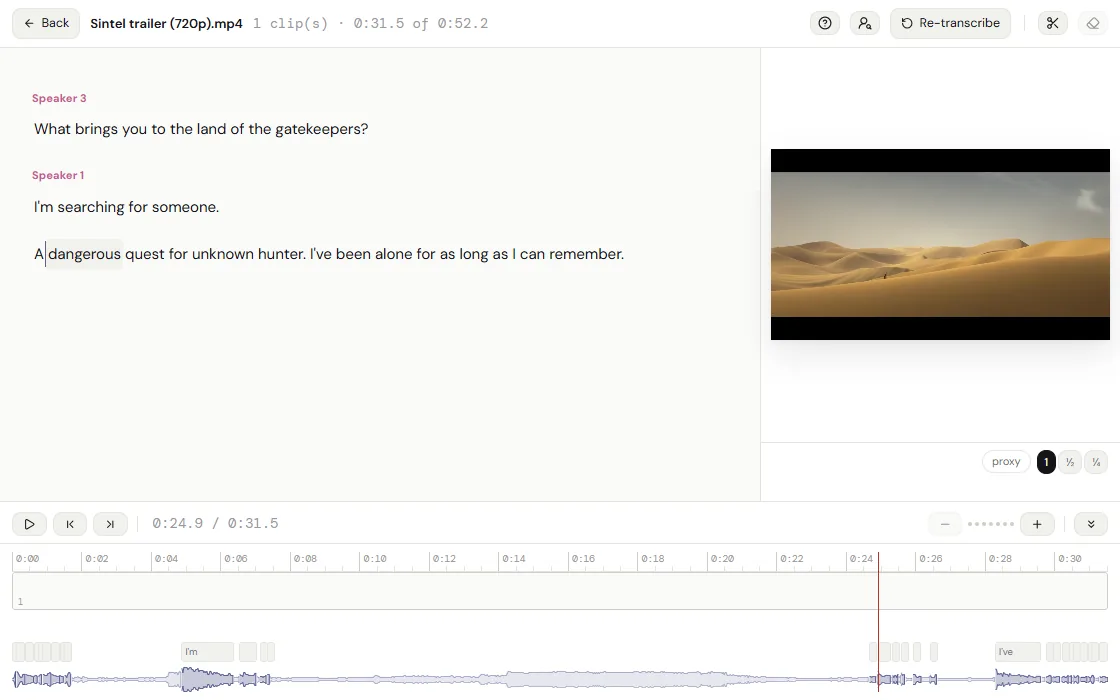
Transcribed here, in the tab, with nothing sent anywhere.
- TranscriptionWhisper in the browser, two model sizes, many languages.
- SpeakersWho said what, told apart and named.
- Cut by the wordsStrike text in the transcript editor and the picture and the sound follow.
- Search spoken wordsThe bin finds a clip by what is said in it.
- CaptionsWritten on the timeline. An .srt beside the export.
- On-screen textA scan reads the text in the picture, so a slide is found by its title.

Capture
Recorded straight into the bin, without leaving the page.
- ScreenA screen, window or tab, with its audio and the microphone.
- Screen and cameraThe screen with the camera in its corner.
- Camera and voiceThe camera, or the microphone alone for a voice-over.
- Photo and screenshotOne frame from either, as an image.


Files
Offline first. The work is in this browser, and it leaves as one file.
- No account, no uploadProjects and media live in the browser’s own storage.
- Works offlineInstallable. The app keeps a copy of itself.
- Media by contentEvery file is known by its hash: shared between projects, relinked by it.
- ProxiesLighter copies for playback. The export never uses them.
- HEVC without the GPUAn H.265 file is decoded by FFmpeg in wasm and kept as H.264, so a driver that cannot take it never sees it.
- BackupsOne .cutvid file with the document and every original it uses. Restore it anywhere.
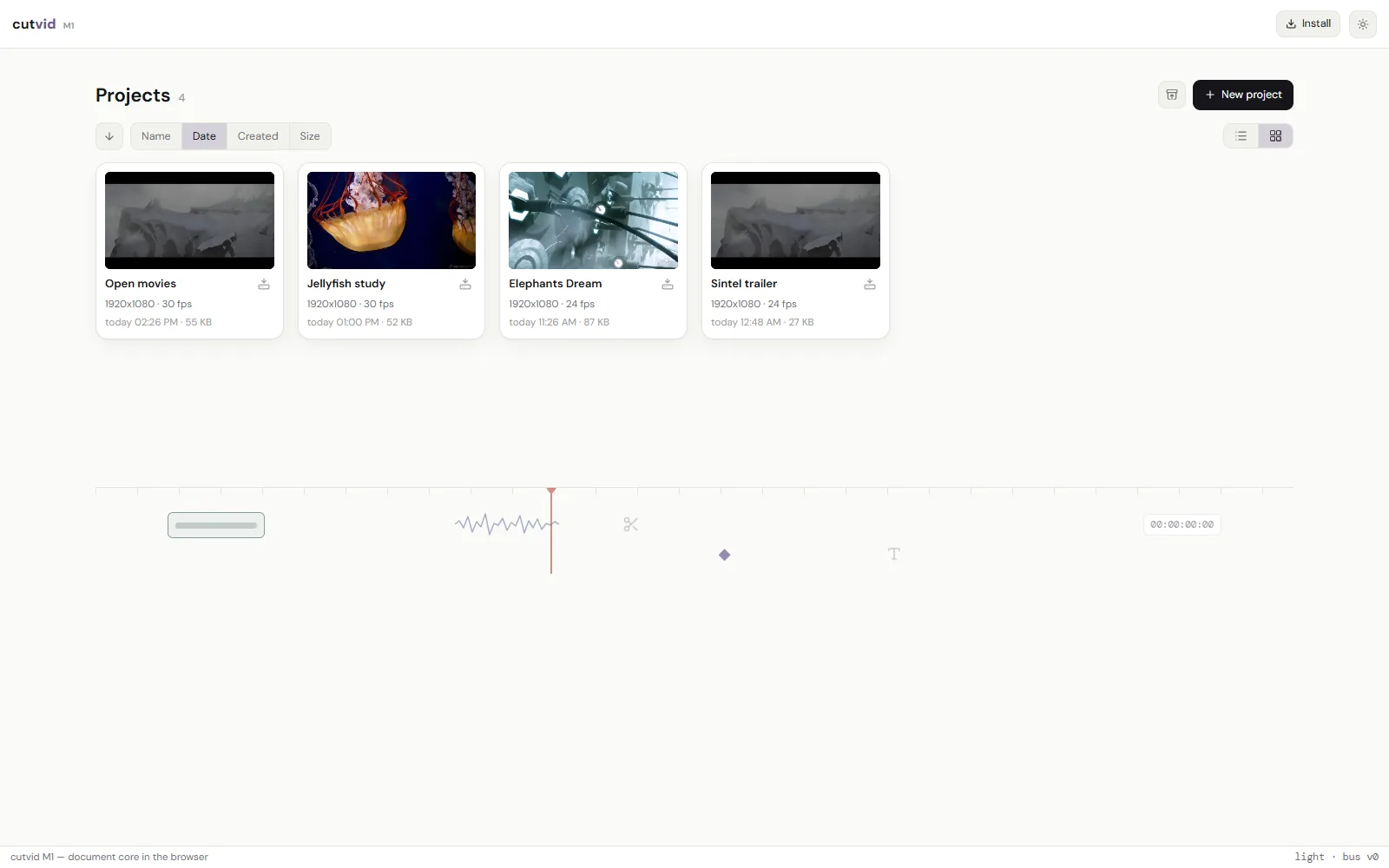
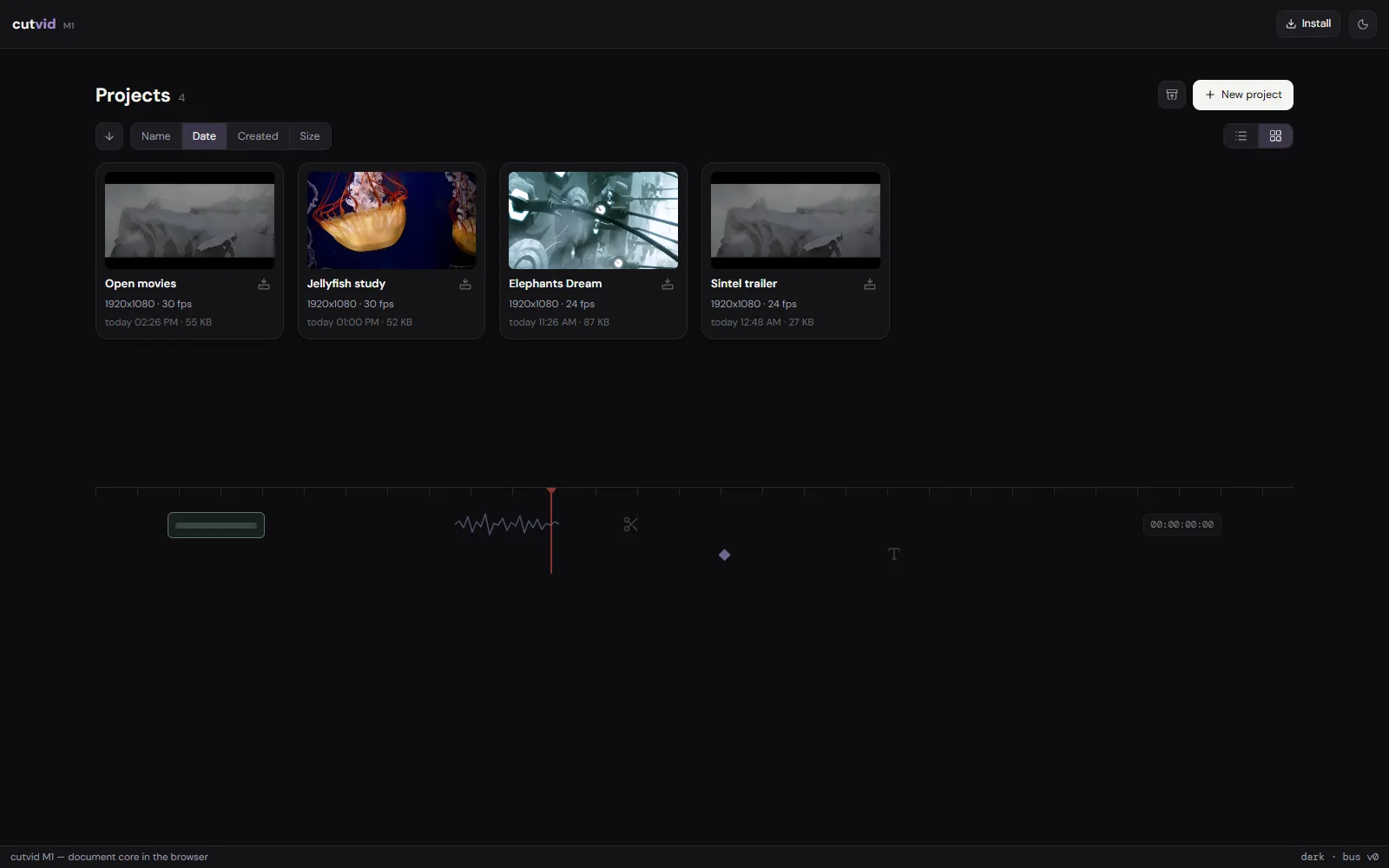
- Every export in one placeThe projects screen lists the renders kept in every project’s .exports bin: play, download or delete without opening one.
- A CRDT documentEvery edit merges. Two copies of a project come back together.
Export
Rendered in the tab with WebCodecs, straight to a file.
- MP4, H.264 and AACOr the sound alone as .m4a. Presets, or a size and a rate of your own.
- Rate controlA bitrate, or a quantizer for an exact quality.
- RangesThe whole sequence, or the part between the marks.
- PreflightA missing original stops it. Everything else is a warning that can be read.
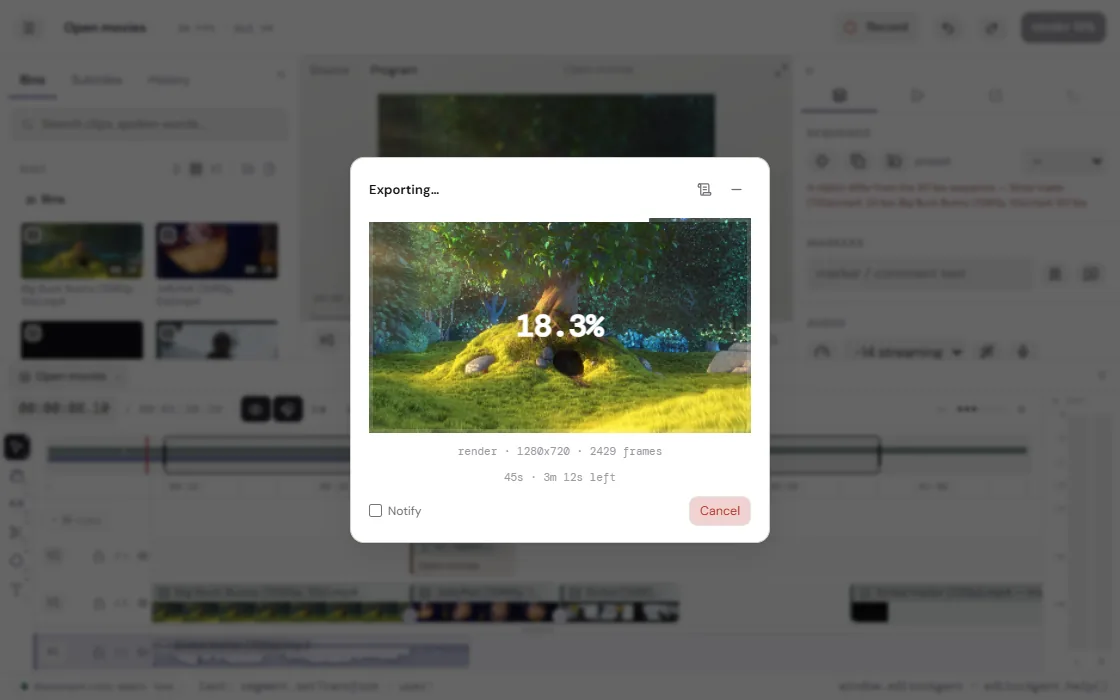
- The frame while it runsThe picture being encoded, on screen, so a mistake shows here and not in the file.
- Left to itselfOr in the activity dock, the file saved the moment it is written. Keep editing, or open another project.

Open it and cut something.
No account, no install, nothing uploaded. The first edit takes as long as a page load.